Friday, April 1, 2011
MBTI: How to survive working for a ‘J’ if you’re a ‘P’
Thursday, October 28, 2010
The wonderful nightmare of 3.5 million career choices
Sally: I'd like the chef salad please with oil and vinegar on the side, and the apple pie a la mode.
Waitress: Chef and apple a la mode.
Sally: But I'd like the pie heated, and I don't want the ice cream on top. I want it on the side, and I'd like strawberry instead of vanilla if you have it. If not, then no ice cream, just whipped cream, but only if it's real. If it's out of the can, then nothing.
Waitress: Not even the pie?
Sally: No, just the pie, but then not heated.
Sometimes we make life too complicated. I was the team leader at my strategy consulting firm, working for one of the world’s largest technology companies on their telecom strategy. Our client wanted us to evaluate every opportunity for them by geography, by carrier, by user type, by step in the value chain, by product, by value proposition. There were over 3.5 million opportunities to consider. And we only had six weeks. I calculated that if we assessed one opportunity per minute it would only take us seven years to complete. Assuming we didn’t sleep (which was a reasonable assumption).
Of course, being strategy consultants we managed to reduce the entire project into a decision for the client between three strategic choices. 1) Make a bold acquisition 2) Try and do something dramatic on your own 3) Keep calm & carry on (but miss out on lots of $$). I don’t mean to belittle our work, I actually think we did a first-class job at tackling that issue, what I am more interested in is the issue that our client was in – that of being overwhelmed by choices.
In psychology circles, this circumstance is known as the ‘paradox of choice’. Barry Schwartz wrote quite a good book about it and like everyone these days, spoke about it at TED.
Businesses face a paradox of choice over which consumers to target, which products to supply. Consumers face one when it comes to signing up to the right mobile phone plan. And we all face it when trying to choose between different career paths. Whatever job or career we choose, we fear missing out on all the other choices that we are implicitly turning down.
Personally I faced it last week when trying to decide where to go travelling with my wife and daughter. We opened the atlas and, it turns out, it’s a big world out there with lots to see and experience. This was clearly a good problem to have.
What I find interesting is that when faced with an overload of permutations & combinations, we often don’t make the wrong choice. It’s more subtle than that, instead we hit the snooze button on the choice and simply do nothing. This explains why people don’t sign up to retirement plans in their 20s. By selecting from the plethora of financial options out there, we risk picking the wrong one. Instead why not just agree with ourselves that we’ll come back to it in a year. Which of course we don’t.
A good friend of mine, Dan is one of the most talented strategic minds of his generation. He got a top first from Oxford, went to BCG and then Harvard. He is extremely calculating about everything he does, every career move that he makes. But as his friends, we tease him about how long it takes him to make a decision. After his MBA he decided against going back into consulting because he wanted to figure out the optimal career move. Four years later and he had drifted between part-time consulting work and then landed a sub-optimal strategy job while he waited to make the perfect decision. Upon reflection he told me that he wished he had just made a “good enough choice” straight after his MBA and got on with life.
Dan was trying to optimize between 3.5 million career choices. But by the time he had computed the answer to this ultimate question, the world had moved on and then there were 3.5 million new choices to optimize against. Perhaps what we all need is to borrow a lesson from the strategy consultants and consider what are the big three strategy choices that we are faced with. And then we can get on with living and enjoying life.
Tough questions
- What are the 3 strategic career choices that you need to choose between?
- If you have no idea, who can help you frame them one a single sheet of paper?
- How will you make your decision?
Thursday, October 7, 2010
Mentoring mistakes
“Always two there are, no more, no less: a master and an apprentice.” – Yoda
My first mentor chat was intimidating. It was week one in my new graduate job in strategy consulting when I met my officially assigned mentor. After shaking my hand, he looked at his watch and announced “I’ve got eleven minutes, let’s make it quick” and we marched across Trafalgar Square to a coffee shop that he liked. I don’t remember much about our conversation or the coffee but he said something that I’ve always remembered. “Look I’ve got two pieces of advice on how to succeed at your job. First, if you ever drive to a client in a rental car, always put the rental car receipt and papers in the passenger side glove compartment; that way you always know where they are even if you are in a rush to return the car. And second..” he raised his eyebrows “…don’t ever fuck up”.
Now this was memorable though not especially helpful advice. Since then I’ve had my fair share of advisors (some incredible, some…well not so much). In this post I want to describe three common mistakes that I see young professionals make with regard to mentoring.
Mistake 1: Searching for ‘the one’. Obi Wan. Mr Miyagi. Dumbledore. Watching movies and reading fiction gives us the deep impression that we should be seeking some Gandalf-like figure in our professional lives. They will pop-up occasionally in our work to pass on sage wisdom. Whispering pithy guidance in our ear, we will go on to triumph & glory. We expect mentors to speak like Yoda. Instead we end up having coffee with an exhausted executive who it turns out has a couple of good ideas and a bunch of neuroses. We expect one person to embody everything we want to become, advise on all areas of our work and life and then it turns out instead we’ve been paired with a human being instead. How unfair.
So instead of seeking one perfect mentor, I strongly advocate getting a “Board of Advisors”. Seek out a selection of mentors who can offer guidance on a specific topic. Want great advice on work-life balance, career goals, navigating politics, professional growth, building a network, influencing senior management? It’s unlikely that you will find one genius that gives you everything.Mr Good To Great Jim Collins writes about finding seven tribal elders who can acts as your Personal Board of Directors. He reflects:
“The best personal boards contain a diverse spectrum of backgrounds and perspectives. Members of my own personal board have come from many walks of life—an expert on personal creativity, a founder of a corporation, a fellow professor of entrepreneurship, a former Vietnam POW, and a public servant. Personal-board members should not be selected primarily for their ability to help you attain success in your business. Every board member should pass this litmus test: "If I were in a totally different profession or business—indeed, if I were not in business at all—would I still have this person on my board?"
Mistake 2: Needing to make it official: Senior executives I have spoken to say that they fear the junior employee who asks them to be their mentor. They worry that they don’t have the time, that it will involve having to go for long dinners in trendy places with loud music. They’d prefer to be playing tennis, or spending time with their friends & family.
Some of the best mentoring I have had has been in the backs of taxis, during small talk at the end of work meetings and at friend’s weddings at drinks before the long dinner. The other person probably doesn’t see it as mentoring, just a friendly conversation with a young face. The key here is to remember to ask for informal advice. Try this: “In your experience, what mistakes do you see people like me make?” or how about “What career advice to you have for someone like me?”. They might pause, think and then come up with a couple of gems. I did this last week to a very senior executive and he quipped “you rise and fall to the level of your peers”. I found this rather profound and helpful. Cultivating unofficial mentors is the way to go.
Mistake 3: Confusing Mentors and Sponsors. I just finished “Why Men Still Get More Promotions Than Women” by Herminia Ibarra in the September 2010 of HBR. It’s a goodie. While the article focuses on differences between the mentoring that men and women get, the key insight is that there is a big difference between a ‘Mentor’ and a ‘Sponsor’. Mentors offer “psychosocial” support for personal and professional development, plus career help that includes advice and coaching. On the other hand, sponsors actively advocate for your advancement. They give protégés exposure to other executives, they make sure their people are considered for promising opportunities and challenging assignments. I had a housemate who went to work for Price Waterhouse Coopers, in his first year the PWC office head took him aside and said “I see a lot of me in you. You could run this place in due course. I’d like to help you.” Now the office head might have said that to everyone who started but I don’t think so. Now that’s a sponsor. Do you have anyone who is actively fighting for you?
So back to my coffee in Trafalgar Square. I asked him if he had any other advice. He said, “sure, succeeding at work is 10% about knowing how to do your job, it’s 40% about doing it fast & getting it right first time; and it’s 50% about getting on with people”. As I look back over the last twelve years, I think he might have been right. Not Yoda, but still better than trying to figure it out on my own.
Tough questions
- Who are the top seven people who could be on your Personal Board of Directors?
- What question can you plan to ask senior people who you respect?
- Do you have a sponsor who has your back and fights on your behalf?
And finally:
"Well, as an older mentor figure, the most likely scenario is that I'd return only to be randomly killed by an enemy of yours so that you can cradle my dying body while swearing revenge — so don't take it personally if I say that I sincerely hope we never cross paths again." — Julio Scoundrél, The Order of the Stick
Thursday, September 2, 2010
What should I do with my life? Three approaches
Last week I was sitting in my office that overlooks Times Square in New York when I got a phone call from the CFO of one of the largest global food & drinks companies. He wanted some urgent career advice about a new job opportunity that had come his way and he didn’t know how to evaluate it. He had ten minutes.
Backing up for a moment, over the last few years I have worked with hundreds of professionals helping them to try and answer the question “what should I do with my life?”. Some of these conversations resulted in dramatic realizations; and others… well, not so much. I have noticed that each person seems to struggle with one of three large issues. This is a quick attempt to outline the three approaches to tackling these issues. These are fleshed out notes from a speech I gave last month. Hopefully they make sense without the PowerPoint slides.
[A quick aside: back in 2004 I signed up with the Coaches Training Institute to train in the art of life coaching. It comprised six long weekends in a stuffy hotel room. Picture a twenty eight year old in a room full of unhappy overweight ladies who all want to help people for a living. We did trust falls and everything. I learned that life coaches are very well-intentioned, most struggle to make a decent living and that I should scuttle back to strategy consulting as fast as I could.]
However I made a resolution that if anyone ever asked me for a career conversation that I would say yes, no matter how busy I was. If you asked me to summarize what people are struggling with I would say:
Struggle 1: “I don’t know what I like or what I’m good at”. These folks tend not to have reflected on what they have enjoyed or succeeded at in the past.
Struggle 2: “I don’t know who I want to be when I grow up”. People in this category can’t make career decisions because they don’t have a clear end in mind. They tend to keep themselves busy so they don’t have to think about it.
Struggle 3: “I quite like what I’m doing but I worry that I’m just drifting”. These people tend to be quite content but worry that they will end up having a mediocre and somewhat undistinguished career.
Of course we all wrestle with each of these to some extent for all our lives. I recommend thinking about yourself & your career with three time perspectives. There is nothing profound about this but it tends to be quite helpful:
The past - What you have done in your life to date? Who you have been? What have been your highs & lows in your journey so far?
The present – Where are you right now? What’s working for you? Where are you stuck?
The future – What it is you are trying to do? Who is it you are trying to become?
The Past: reflect on your history
Part of the answer is in looking backwards and understanding how you got to where you are today. Most people in their rush to advance, resist looking in the rearview mirror. After all aren’t we all supposed to have no regrets? We all need to understand what it is that gives us energy and in what do we have experience in. I have written about this before and about being good at things you don’t enjoy. Here’s a useful matrix:
Simple ideas:
- reflecting with friends, family and colleagues and asking questions like “When have you seen me get most energized about work? What did you notice?”
- online strengths-diagnostics surveys like one that comes with the Strengthsfinder 2.0 book.
- glancing through your hard drive of old projects and work you’ve done. Look in email folders to prompt you to think about different work experiences
- Take a family photo album off the shelf and flip through it. Recall times when you’ve really enjoyed life or accomplished the most (and also times that you have been miserable or really struggled)
The Future: write the end of the story
We all face the luxury of unprecedented choices with our lives. We are the most overqualified, most educated, luckiest generation in history. We can do anything, go anywhere and we don’t have to follow in our parents’ footsteps. And yet this freedom turns out to be a terrible burden. Psychologists call it the Paradox of Choice. It’s a real problem. There is likely no single future perfect job that is sitting in a classified advert waiting for you to browse over a Sunday morning coffee.
The people who love what they do tend to have actively experimented. They didn’t know exactly what ‘it’ was. Instead they dreamed up three of four future selves that they could get excited about. Personally I can imagine being a business school professor, or running an online education company, or writing comedy screenplays. These are all future selves that I can get excited about. And I need to find ways to experiment with each to see if they are compelling careers or just nonsense that I’ve made up in my head.
So far, so obvious. Here are some tips that I’ve seen executive coaches use to help people understand who it is they could become:
- Write 3 x 200 word eulogies. One from the perspective of a business colleague, another from a member of your community, another from a friend or spouse. This is a slightly better exercise that writing your own obituary since is will focus you more on who you aspire to be versus what you would like to accomplish and be known for.
- Ask friends: “what do you see me doing in ten years time?”; often what’s obvious to them is not to us.
- Reread any past essays when you have written about your hopes & ambitions. Dig out those business school applications
- Try and answer the question: ‘what would I do if I knew I couldn’t fail?’
The Present: what's your story?
In our rush to over-achieve, we are all at risk of forever rushing to the next meeting, jumping on the next flight, replying to the never ending emails. We forget to pause, check in on ourselves and ask: are we remembering to enjoy the journey?
We have a deep need for life to make sense. We need to have a story that helps us connect the dots to the past and future. We need a sense of coherence that explains where we are coming from and how that connects to where we are heading. This is about having a personal narrative. In the story of our lives we are the protagonist. So the question is: are you living a good story?
I’ll save the detail for now, but we can learn a lot from great literature and movies about what we as humans like in a good story. Then we can apply those lessons to our own lives. Do we want to live an epic quest? Are we in a romantic comedy? Or is it a recurring tragedy? Unless we have a sense of where we are in the story of our lives, it is no surprise when we feel unsettled or adrift.
Tips include:
- Keep a journal, noting down highs & lows. When on a long flight or commute, take 5 minutes to reflect where your current work could unexpectedly take you
- Which movies or book characters do you most admire? What would you need to do to live your life more like them? What would they do in your situation?
- Write down your life story to date in the form of a movie plot.
- The next time someone asks you “What do you do?” try out a new story, come up with a response that intrigues the other person. Tell them you are considering changing careers, or taking up an unusual hobby, or moving to Africa. See where the conversation takes you and what ideas it gives you.
I have come to believe that this final approach – finding our own compelling narrative, is the hardest to get my head around. It’s also the one that I struggle to articulate in writing. The chapter in Working Identity by Hermina Ibarra on sense-making is very good: Working Identity: Unconventional Strategies for Reinventing Your Career
Anyway, where was I? When I speak with people about their career strategy, they normally can identify if their issue is with the past, present or future (or some combination). We can then focus in on what it is they need to do to move forward. And the CFO of the global food company? For him it was about understanding his past. He needed to understand his strengths and areas of expertise. What was the most useful thing he said he did after we spoke? Well he told me it was leafing through all family photo albums reflecting on different parts of his life and spotting patterns with regard to what energised him.
Tough questions
- Which of the three approaches (past, present & future) is most relevant to you?
- What story are you living? Do you have a clear narrative of where you are in your own life story?
Friday, August 6, 2010
Does your job impress strangers?
If you go out in London on a Friday night and chat to a bunch of twenty-somethings, there are two questions that you needed to have good answers to: ‘where do you live?’ and secondly ‘where did you go to school?’. It is delightful to see that the class-system is alive and well. In New York it is a similar question though a little more veiled: ‘what do you do?’ Or put another way “in two sentences or less please justify why I should bother continuing this conversation with you?” If you don’t have a quick, amusing yet intriguing answer then you will see it in their eyes. Unfortunately “I’m an accountant” just won’t get you invited back for a late night coffee. Social status is not just important when you are a teenager. We crave it all our lives.
When I was at university the highly prestigious jobs seemed to be in Strategy Consulting and investment banking. These days it’s all about hedge funds, web 4.0 and non-profit-venture-capital-social-network-media-entrepreneurism.
Actually that’s not quite true. A Harris Poll last year found the most prestigious occupations to be firefighters (62% said it is a very prestigious profession) closely followed by scientists, doctors, nurses & teachers. At the bottom end of the scale are Real estate agents, Actors, Stock Brokers and our poor friends the Accountants.
This Mitchell & Webb video says it best (a good 2 minutes of your life I assure you):
Like in the video, should we really be pursuing a part-time human rights law degree or is it OK to moan about a job in our metaphorical ice-cream factory. Surely we shouldn’t care what other people think about us? Of course we shouldn’t, but of course I do. Our career and jobs become an integral part of our identity. Researchers have uncovered “a significant and positive relationship between occupational prestige and happiness”. Or put another way “people love boring other people about their work”. When you think about it this makes sense. We know that on the flip side: unemployment hits people really hard. People often sink lower and take longer to recover after losing a job than when their spouse dies.
So should we conclude that we should all chase after the latest cool jobs? Of course not: but this is where we tend to make a mistake. There’s a profound difference between what you actually do and the story that you tell about it. When asked “what do you do?” we feel vulnerable. But there are other tactics we can adopt, I always pretend that they have asked me “What exciting things are you planning to do?” and I tell them about amazing companies I might one day set up or difficult questions that I’m grappling with. Strangers instantly clutch onto one of my outlandish ambitions and we then often have an interesting conversation while swigging Brooklyn beers. My responses include statements like: “well my wife and are thinking about going to live in India…” or “I’m considering starting up a online company that delivers happiness at work…” These responses are grounded in truth but also reflect my aspirations – and so no-one needs to hear about my mundane day to day existence. Is this just an avoidance tactic? Probably. But it makes for a better Friday night out.
Tough questions
1. What is your best response to the question “What do you do?”
2. How much of your identity is tied up in your firm, your colleagues or your
Tuesday, June 8, 2010
Why are some jobs better than others?
When I was eighteen I spent a year volunteering as a teacher at a high school in rural Zimbabwe. I taught English, Mathematics and helped coach the school volleyball team. The kids were terrific & eager to learn, the workload was manageable and every day presented itself with a new challenge. But there was just one problem. I simply didn’t like being a teacher. I would awake each morning with dread trying to think of ways to avoid the classroom. So was puzzled when I read that teachers are happier than everyone else in the workplace. I decided to investigate what we know about job satisfaction, who is happy with their career and why?
First stop: the Gallup well-being index. This suggests that teaching is a route to a happy career. 180,000 interviews across 12 professions gave teachers double the life evaluation score of manufacturing & production workers. Gallup’s research is thorough and thoughtful. However they only compare twelve types of job which was less helpful so I kept looking.
Next up I came across a University of Chicago study, "Job Satisfaction in the United States" which sounded promising. From surveys of ~27,000 people across ~200 occupations it calculated which jobs hold the most satisfaction and conversely the most misery. The vicars & priests top the charts by a margin with firefighters and teachers also making the list. Here are the top seven jobs:
What should we make of this? Being a priest would seem alright – helping your flock get into heaven – pretty fulfilling for an afternoon’s work. Now fighting fires gives you excellent bragging rights in a nightclub. Then authors get to stay home and procrastinate while watching hours of bad daytime TV and then sitting in nice cafes trying to overcome their writer’s block. Painters and sculptors? Well that one surprised me. Most artists I know are lonely, broke and not getting the recognition they secretly crave. So how about at the other end of the scale? Well here are the seven jobs with the lowest job satisfaction:
Some of these make sense. Carrying heavy roofing materials up ladders in the rain doesn’t sound like much fun to me. Waiters are mostly unhappy because their acting talents remain overlooked. Laboring, hand-packing and freight handling were also not jobs I had discussed much with my university career advisor. And that’s precisely the problem with these lists. Where are the investment banking analysts? Where are the Advertising account managers? Where are the supermarket produce buyers? Where are the management consultants, the non-profit lawyers, the web 2.0 entrepreneurs, the corporate communications writers, the consumer packaged goods brand managers? Where are all the professions that people I know are struggling to decide between?
These are all self-report questionnaires. You can’t tell whether happier people self-select into certain professions. You can’t see why a profession scores higher or lower. Is it the people in the job or the structure of the job itself?
Well this is exactly what the third study tackled. Andrew Oswald is an Economics professor from the University of Warwick in UK. He went beyond job satisfaction and asked what else it could be about the people in the jobs or the jobs themselves. His extensive statistical analysis of over 16,000 people showed that most people do enjoy their work: ~80% of people rate themselves as 5, 6 or 7 out of 7 on a scale of job satisfaction. A number of his insights surprised even him. Happiness in the workplace is U-shaped. People enter the workforce bright-eyed and enthusiastic, they hit a trough in their mid-30s and then gradually morale improves until retirement. This might be because “life tames one’s wilder expectations, and that this process hurts but works”. This is a theory of acceptance.
Oswald found women are consistently happier than the men. Researchers are still squabbling about why this might be so (e.g. are men just hard to please?). Work somewhere that feels small – avoid impersonal large organizations where you become an anonymous cog in the machinery. Ensure that your boss doesn’t control the pace of your work, let it be driven by you, your colleagues or your customers. This one really is critical. One option is to be self-employed. Next, says Oswald, make sure you don’t become overqualified – having more education is negatively correlated with job satisfaction. Avoid working in big cities where you have a nightmare commute – moving to the suburbs to get a larger house and outdoor grill is an alluring but bad trade-off.
Oswald also reminds us that it’s not just about what you think of the job, but what do others think about you? Does you job and title carry the necessary “wow factor”. Occupational prestige, as it’s called, is immensely important to our self-esteem and something I will tackle next week.
So after reading all this I considered whether we should all quit our jobs and become priests. I spoke to a friend who went into the Catholic Church after university. He was a highly successful priest. Did he have high job satisfaction? Yes indeed, he told me, but it wasn’t everything he wanted so in his early thirties he changed career. He became an investment banker at Merrill Lynch…
Tough questions
1. Who controls the pace of your work? How can you get more control?
2. How socially connected are you at work? How could you enjoy your colleagues time more?
Thursday, May 27, 2010
Rethinking the week
My morning coffee in Brooklyn last week feels like four years ago. Since then I have presented in Boston, trained in Los Angeles, passed through Denver, narrowly avoided running into a buffalo in Wyoming and am now en route to Vancouver. While I might picture myself as George Clooney’s Up In The Air character jetting at 35,000 feet, the reality is a lot less glamorous. For starters, I have no airline status so upon entering each aircraft I have to turn right. So as I sat in non-reclining seat 43G, I reflected on how I currently spend my time each week and whether I could be doing things differently.
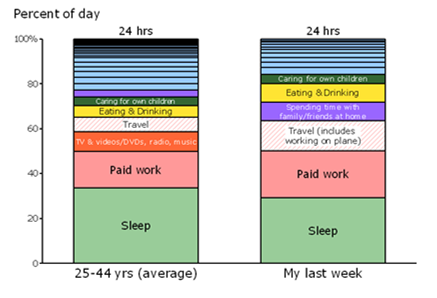
To see how I was faring against my fellow man, I checked out the 2008 American Time Survey. I found that the ‘average citizen’ spends 8hrs 30mins asleep each night and those that watched TV do so for 3hrs 40mins each and every day. Upon discovering this I instantly felt under slept and understood why I have only just finished the first season of Six Feet Under. Clearly I am no ‘average citizen’ so I turned to the 2005 UK Time Use study which breaks out 25-44 year olds and shows exactly what they do with every spare 5 minutes.
In order to compare myself to the ‘average 25-44yr old’ I went back and tracked every 15 minute chunk of time I had spent in the last 7 days. I mean every taxi, each airport meal, the calls to friends, the aimless surfing of the internet. If you haven’t ever done this exercise, I really don’t recommend it. It became readily apparent that my life is rushing by and I can’t even recall half the things I do each week. After nearly an hour of searching through my Outlook calendar I pieced together a loose approximation to my last seven days and proudly enter the data into Excel. Versus the average person my age I am spending more time than average travelling (which I already knew), I spend less time watching TV (again -not news, I have three seasons of Lost on DVR) and I work longer than average.
However the interesting stuff on this chart is all hidden away in the little blue segments at the top of the two bars. All the smaller moments of time that don’t fall into bigger buckets. Instead of looking at how I spent my time I decided to ask myself the question: “Where do I get my energy?” I drew a calendar breaking out my time for the week. I went through it and looked at: Where I had been most productive? Where I had wasted time? Where I had really enjoyed myself? Where did I have my best ideas? This was much more revealing.
On Wednesday afternoon I realized I should have run a meeting very differently. Then I noticed that each time I had gone running for 30 minutes I had had a much better day. Finally I made the totally obvious but nonetheless big observation that hanging out and playing with my baby daughter beats aimlessly surfing wikipedia any day.
Back in mid-90s at university, my tutor taught us how Economics is the study of scarce resources between competing ends. Of course life is just the same. We can't choose our parents, our genes or our taste in music. But we do get to choose how we spend our money, time and energy. After spending this last week up in the air, I am going to focus much more on what truly energizes me.
Tough questions
1. How do you really spend your time today?
2. Reflecting on your past week, where did you draw the most energy? How can you repeat that more consistently?
3. If you had to do the last week again, what would you do differently?
Thursday, March 18, 2010
Three automation experiments that worked
I actively detest shopping. I derive no satisfaction from department stores. When I was eight I got lost in Selfridges in London for what felt like three days. I still experience flashbacks. So no surprises that I love online shopping. There is nothing I like more than opening my front door on a Saturday morning and the nice men from Freshdirect handover boxes of fresh veg and goodies for the week ahead. In fact I got thinking about other repetitive tasks that I dislike and what can be done so I never have to do them again. Here are three New York experiments that I tried and really liked.
1. Socks. I recently signed up to Manpacks. Although it sounds like a dodgy online service for discounted viagra, it is actually a subscription service that delivers fresh new socks, boxer shorts and t-shirts to my front door every two months. Buying socks in a store is time I can never get back. I had already switched to using Amazon.com but now this is even easier. One ‘manpack’ every two months will, on average, replace my wardrobe over two years. Brilliant.
2. Checking voicemail. For some reason I really dislike having to check my voicemail. I tend to do it about once every three weeks and delete all my messages at speed. I signed up to a service most excellently named: voicemailsucks.com. The product is called Phonetag and it automatically transcribes every voicemail you get and emails it to you. I must admit that I love it. It transcribes about 90% of the message correctly and, if you are confused, it also sends you an MP3 of the voicemail. Importantly it always seems to transcribe phone numbers that people read out correctly. I pay per message and the cost is negligible.
3. Never run out of toilet paper again. My wife and I signed up to Alice which automates the delivery of boring household goods to your house. It predicts when you will need various good like toilet cleaner or shampoo or recycling bags. Every few weeks a box arrives with stuff we need. No longer to we have to having a soul destroying marital conversation about laundry detergent. Now of course you do have to tell the website how often you go through various products and then adjust it if you over or under-estimate your consumption. But now it sends me a new toothbrush every four months and I know it’s time to throw out the old one. I simply don’t have to think about it. Shipping is also free which is nice.
Thursday, March 4, 2010
In praise of putting your feet up
Time to read this post: 3 minutes

I like the idea of being organized. I go to friends' houses and admire their zen-like living rooms. I buy books like "Getting Things Done" by David Allen and put them neatly onto my bookshelf. But whenever I write "organize junk in home office" on my to-do list for Saturday morning, I am always unable to complete it because I urgently need to read the new Economist. For three hours.
I recently picked up a copy of "Organizing from the Inside Out" by Julia Morgenstern. It has 320 pages of proposals to analyze your clutter, creating action plans and getting the job done. I tried to read chapter 17 on "Closets. What's working? What's holding you back?". I read Julie's No-Brainer Toss List for Handbags and Briefcases. I even tried to diagnose whether the root cause of my issues were
Level 1: Technical errors - simple mechanical mistakes in my organization
Level 2: External realities - as far as I can work out, this one basically means that you're screwed
Level 3: Psychological obstacles (e.g. #12 Are you a highly visual person? #19 Did you have a traumatic childhood?).
Now I have no doubt that everything in the book is extremely sensible but every few sentences I found myself urgently needing to take a twenty minute nap. So what to do?
Well the answer is extraordinarily simple. Get someone else to do it for you. Lots of people love organizing things. They write books about it. They buy all the books about it. They do it for a living. And you too can pay them to do it all for you. Without having to address any psychological obstacles or technical errors. And they're surprisingly good value.
So my wife and I contacted Nicole at Genius Organizing and booked ourselves in for a home session with her. Nicole told us to order in some good food, have some good music ready on the iPod and she'd show up at 6pm for a 3 hour blitz. She sent us a nice email telling us not to think about our clutter a moment longer and she would fix everything. And, quite to my astonishment, she did.
The actual evening was somewhat of a blur. It involved Nicole marching around demanding things like: when we had last ever opened a particular filing cabinet. "Um" I would reply, "about twice a year". So she told us that 'We're going to scan it all in so you can have it all electronically and pull it up faster than you can find it in the piles of junk'. And by "we" she meant her and her colleague, Julie.
Julie arrived to pick up piles of my MBA lecture notes. She would scan them all in for us, categorize them into electronic folders and deliver them all back on one USB stick. Then I thought our closet was in reasonable shape. Apparently I was mistaken. We were able to throw out 28 bags of junk including many random objects that have followed us around the world as we moved and I didn't even recognize. And by the way, I don't mean plan to throw it out, I mean throw out. By 9pm it was all sitting outside ready to be picked up by Brooklyn's loudest garbage collection men at 4am. This really was genius.
So that was it. Oh and I just found out this week is National Procrastination Week. Watch this for a brilliant guide for how to procrastinate properly:
Saturday, February 27, 2010
Putting off the good times: Decision-bundling
Time to read this post: 5 minutes“I love deadlines. I like that whooshing sound they make as they fly by” said Douglas Adams.
To explain let us go to an apartment in north London on a cold November night in 2002. It’s 2am. I’m with my American friend Dave and we’ve been drinking beers. After nine years he still hasn’t proposed to his hot, intelligent and fun girlfriend, Emma and I’m confused. So I ask him, ‘When are you and Emma going to get engaged?’ Dave thought about it and shook his head. ‘I want to but I can’t’ he replied. ‘Huh?’ I probed.
Dave’s dilemma is common. We find ourselves unable to make a decision that we actually want to make because of a series of other decisions that we have bundled together with it. Dave had bundled a relationship status change with career changes, geographic uprooting and having to start a family. It was all nonsense of course as he readily admitted. Emma wasn’t pressuring him to make any of the other changes. He had created this compelling sequential narrative in his head and if he made the first move then the rest was simply inevitable.I thought about it more and realized that I too fall victim to ‘decision bundling’. Let’s take the visiting the dentist. I see myself as a responsible person who brushes and flosses regularly. But I’ll be honest, I don’t actually floss regularly. And going to the dentist means having to acknowledge my lack of flossing and thus, my irresponsible approach to life. So I postpone my dentist appointment until the next month and try to change my decision not to floss. I’m an idiot.
I believe that decision bundling can lead to severe procrastination in one specific instance. When we have to make a decision that forces us to acknowledge that we are not being the person we aspire to be. We may believe that we have integrity. That we are generous. That we are trust-worthy. And yet to call up and cancel on our friend’s invitation would show otherwise. So we do nothing and hope the situation will magically resolve itself.
To make a decision to open a savings account would shows that up to now, we have not been financially responsible. So we do nothing and our personal wealth continues in disarray.
Where do you bundle decisions in your head? How does it hold you back? Is there anything we can do about it?
Thanks to everyone who reposted / tweeted / emailed me about my last post on mistakes that smart people make. It seemed to resonate
Saturday, January 30, 2010
5 mistakes smart people make
When I ask people to summarize what they are wanting out of life they throw out a lot of words. Stuff like ‘Love’, ‘Achievement’, ‘Family’, ‘Fame’, ‘Peace’, ‘Money’. If you summarize the thousands of responses each aspiration really falls into just two categories.
First, “Success”: deep down many of us want to win the game of life. We want to accomplish something extraordinary. We want to be recognized and applauded. We feel pleasure when we take a step toward this goal. This can show up more strongly in some of us but we all have this need to some extent.
Second, “Happiness”. We want to enjoy our short lives on this earth. We want to fall in love, to experience joy and generally feel good. Both success and happiness are good and reasonable goals. Here’s the problem: they are not the same thing. Many business leaders spend years scaling the mountain of corporate success only to find they feel empty inside. Conversely others seek fulfillment and enlightenment; they believe happiness comes from within. But giving up on their ambitions and dreams is hard - they find themselves wanting to make progress, to take action and fulfill their need to feel competence.
Understanding what will make you successful and what will make you happy are two very important questions. But they are different questions and getting your head around that is step one.
2 .Choice is paralyzing
I know this sounds nauseating but you really are extremely lucky. Of all the times in history that you could have been born, and you go and show up at the end of twentieth century. Good job. Make no mistake the Dark Ages would have sucked. In terms of your life prospects and the opportunities available to you, you are luckier than 99.9% of humans ever to walk the planet. Today we have unprecedented levels of opportunity. Apparently we can be anything we want to be. What a luxury.
Or not. Having an infinite number of permutations and combinations for our careers is not everything it is cracked up to be. Unlimited choice can produce genuine suffering or more commonly, total inaction. When faced with 258 types of cookies in the supermarket aisle many people will simply just walk away. Why risk making the wrong choice?
In the British version of The Office, Tim is reflecting on why he is in his mid 30s doing a job he doesn’t like: “If you look at life like rolling a dice, then my situation now, as it stands - yeah, it may only be a 3. If I jack that in now, go for something bigger and better, yeah, I could easily roll a six - no problem, I could roll a 6... I could also roll a 1. OK? So, I think sometimes... Just leave the dice alone.”
Are you someone who gets paralyzed by choice? When does it happen?
3. Don’t believe your feelings
One of the worst pieces of advice to come out from popular self-help is to ‘trust your emotions’. Take a long hard look at yourself, it says, and you will work out what to do or who you want to become. But psychology has taught us that this is mostly nonsense. We as humans are terrible at predicting how they will feel in the future . If only I could get the promotion then I’d be happy. If only I could take six months off work to go travelling then everything would be good. If I could just lose 6lbs… Furthermore, we are also terrible at remembering what made us happy in the past.
When I’m feeling down and I ‘follow my feelings’ then I typically end up eating junk food on the couch watching Law & Order re-runs. This isn’t very helpful. Similarly making big decisions about your career and relationships when you are not in a good place is even more dangerous.
To oversimplify for a moment: your mental well-being is a complex mix of what you are thinking, what you are feeling and what you are doing. Many life gurus will assert that A leads to B or B leads to C: “Fake it til you make it”…” and suchlike. No-one has proven it conclusively but it’s clear that causality goes in multiple directions.
For example, I find going for a run (‘doing’) makes me feel more energized (‘feeling’) and helps me have creative ideas (‘thinking’). Indeed, I am increasingly convinced that we are “much more likely to act our way into a new way of being than to think our way into a new way of acting” .
All that’s to say if you are feeling stuck in a rut then I would caution you against making dramatic life-changing decisions.
4. Change is not linear
- reflect on what you really want to do, your ideal end point
- identify your options against your fixed goal
- take a series of linear, sequential steps to get there.
The reality is much messier. Successful career changers tend to start experimenting with new job ideas. You might start volunteering somewhere at the weekend. You might go and work-shadow a friend who has a job that kind-of appeals to you.
Change happens in fits and starts. It is rarely the transformative revelation that great novels & movies will make you believe. Neither is it a slow, steady, gradual evolution. You will likely start chipping away at a new idea, suddenly you will get huge traction and everything will be changing and before you know it, it has all slowed down again.
The main message here is that opportunities for significant transitions in your life will come and go. If you are looking to make changes then you will need to embrace these moments of opportunity even though you will never feel quite ready for them.
5. You are good at things you don’t enjoy

In the top left you have your Unrealized Strengths. These are the things that energies you, that you are good at, and that you may not get to do very often. They are by definition hard to identify because you have had less experience using them. In this quadrant lies huge amount of personal opportunity.
In the bottom right, you have Learned Behaviors. These are the things that you are good at, but that drain you when you are doing them. For me this is project planning. Sometimes they are necessary evils. Other times they are the primary way that you are earning your living. Overly focusing on this quadrant is the cause of most people’s unhappiness in the modern workplace.
In the bottom left, you have your weaknesses. You are neither good at these, nor do they give you energy. These are best avoided at all costs.
Thursday, October 29, 2009
Top 10 approaches to enjoy work
Time to read this post: 6 minutesIt's time to take a position. Why do some people consistently love their work? After multiple degrees, hundreds of academic books & articles, years of interviewing people in their work, I want to summarize what actually works. For people who love their work, what is it that they do? What are their tricks? Their secrets? This may eventually turn something more than a blog posting. For now I want to share the ten most effective approaches that I have learned on my journey thus far.
Three is the magic number. Most self-help books will tell you that there are three rules, three secrets, three pathways to happiness. A holy trinity. Three is a good number because most of us can't remember more than that. I can't recall the names of the seven dwarfs let alone the fifty ways to leave your lover. But what bothered me was that each each academic or book that I read cited a different three. One has Pleasure, Engagement & Meaning. The next has Strengths, Flow and Mindfulness. Or Achievement, Savoring and Love.
What seems to be the problem? Imagine a company that is losing money. Before we can assess what to do, we need to understand the firm's current situation. What is its competitive position? How much money does it have in the bank? What do its customers think of the products they sell? Do employees enjoy working there? Only then can we offer an initial opinion. And yet with people, authors and academics ignore all of that and tell us there are only three things to consider. I'm sorry, but life's more complicated than that.
I have tried to synthesize every major theory about what influences how we enjoy our work. It draws from behavioral economics and Greek philosophy to top athletic coaching and Positive Psychology. It's not a comprehensive list but it's my best starter. I have boiled it down to the ten most important approaches. And I bet that three of them are highly relevant to you. But it probably won't overlap with the three on my list. Over the coming weeks I will explore each of these in turn.
Top 10 approaches to enjoying work (as of October 2010)1. REFRAME: One way to enjoy work more is to reframe your challenges and time in a more positive light. You might ask yourself each morning "What's going to be good about work today" or start a meeting with "What's going well on our project?". You do acknowledge where you are behind, or what's going wrong but your positive perspectives notably outweigh the negative.
2. STRUGGLE: work needs to be tough enough. We need challenge and without it we get bored. It is about having goals that your really have to stretch for; about pushing yourself, about time flying by as you are absorbed in your work. People who excel here have mastered how to set goals well, who jump into projects that both scare and energize them, who let themselves get lost in the moment.3. STRENGTHS: focus on using your strengths each day not just shoring up your weaknesses. People who excel here understand what energizes them and reframe their daily work to use their strengths in new ways. These people know the cards that life has dealt them and they lead with their strong suits. They do know their weaknesses but don't obsess over them. For example if they are highly creative but in a non-creative role they still invent excuses to brainstorm and to let their imaginations run wild each day.
4. SIMPLIFY: declutter both physically & mentally. Life is awash with choices and it's easy to drown. People who excel here don't try and do everything perfectly. They compare the prices of three products not three hundred. They delegate less important decisions to other people. They outsource repetitive tasks to personal assistants. They keep one master 'to do' list so they don't have to remember everything going on. They are happy with 'good enough', it frees up time to do other activities they really enjoy.5. QUIET PLEASE: dampen the constant chatter that runs through your head. We are so used to the running commentary in our brain that we tend not to notice it. People who excel here might practice meditation or they might do active exercise. They are quick to notice if they are ruminating and they know how to stop. If a colleague calls them incompetent they don't take the bait. They can let it wash over them. They have a sense of calmness and serentity about them.
6. CONNECT: make sure you have colleagues who you trust. Actively develop friendships at work. Other people matter to our happiness much more than we realise. People who excel here have colleagues who they can go to for great advice. They have friends who will look out for them and who have their backs. They share the values of their co-workers. They genuinely care about the well-being of those around them. They allow their true selves to shine through and not feel like they are suppressing their true identity
7. GIVE: help other people. This is about making other people successful and happy - both co-workers and customers. People who reframe their work as bringing value to the lives of individuals (colleagues and clients) find they have more meaning in their working lives. They find excuses to do favors for others. They are aware of what they are uniquely good at and use that as a way to offer assistance. Although this is rewarding in itself, these people then find the reciprocity of others overwhelming. They find this approach offers both personal success and happiness
8. REHEARSE: practice all important conversations, presentations and interactions you have. Rehearsing can be boring and so we decide to wing it instead - it'll be alright on the night. People who excel at this approach tend to be obsessive in their preparation for important events. They role-play sales pitches with their colleages who play devil's advocate. They video themselves delivering a keynote speech on their Flip camera and watch it. They brainstorm all the things that could go wrong and plan their response. They walk into the room well-prepared. They find this approach leads to both success and enjoyment.
9. SMELL: appreciate the here and now. Day after day of back-to-back meetings, monotonous commutes, growing to-do lists, it is challenging to remember to enjoy the journey. People who excel at this have mastered the art of being fully present in the moment. When you meet with them, you have their rapt attention. Their lives are busy but they make time to enjoy the small stuff. To make time to enjoy lunch. To switch up their route to work. To stand in the sun in the carpark taking in the view and inhaling deeply. To retain their sense of wonder and fascination with the beauty of the world
10. IMAGINE: have a compelling vision of the future that you are drawn towards. Many of us are stuck in the past, haunted by our past failings, ruled by our fear of failure. People who excel at this approach are not stuck in the past but pulled forward by the future. They are climbing a ladder but know that it's leaning against the right wall. Their vision gets them energized through the tough times. They understand how the current chapter of their life fits into the overall story. They respond to question about "what do you do?" with tales of where they are heading.
Each of these approaches can sound trite. They get boiled down to meaningless catchphrases. I plan to explore each of these approaches over the coming weeks. I will share the theory, the challenges, the tricks & techniques that work for people that I've interviewed.
Tough questions
i) Which of these approaches do you already follow successfully?
ii) Which would most benefit you in your work?
iii) What is the smallest thing that you can do that would make the biggest difference?
© The Tough Guide 2009
Thursday, October 22, 2009
Before you quit your job
Time to read this post: five minutesAbout once a month, I get an email from someone at my company who is confused. They want to change career. They want to get a new job. Sometimes they are just done with work. Almost always they have decided they want their life to be different. But they don't know where to begin. So we get a coffee. We talk about how they feel, what they want, what their plan is. I thought that I would share the two big questions that they tend to grapple with. There are some useful resources and approaches out there and people seem to like them.
Question one: What do I really want to do?
Most of us only have a vague sense of what kind of work would bring us a combination of pleasure, challenge and a sense of meaning. When I ask people over coffee what do they think they want to do they tend to give vague answers. "I'd like to work in finance". "I'd like to get a job in retail". The problem with trying to define yourself by industry is that there is huge variation in job type within a sector. The day-to-day interactions with colleagues, the length of commute, your boss's sense of humour will have much more impact on your levels of enjoyment than the abstract industry it may be part of.
Po Bronson in his book argues that working out what you want to do is actually the wrong question. Instead you need to ask yourself "Who do I want to be?"; "What do I stand for?"; "What values do I want to embody?" Then from that place of being you can then think about doing.
A wise colleague of mine says that when he works with CEOs he gets them to take out a blank sheet of paper. On the left hand side he gets them to write down what they love doing. On the right hand side they write down what they hate doing. He has tried doing this with "what I am good at" on the left and "what I am bad at" on the right - but he says that simply doesn't work. It has to be what you love and hate. For me the things I love would include things like "Being the center of attention when telling a joke; running in forests; working fast to hit a deadline; analyzing data in excel; applying lessons from one academic discipline to another..." These are things that really energize me. So the first step I recommend is to get a clear understanding of what gives you energy and what drains you. This is closely connected to playing to your strengths, understanding what motivates you, what your preferences are.
Practical tools:
1. VIA strengths assessment: go to http://www.authentichappiness.sas.upenn.edu/Default.aspx, login then take the VIA strengths questionnaire
2. buy Strengthsfinder 2.0 by Tom Rath. It will give you a code to do their online test (not as long as VIA)
3. Reflect on your Myers-Briggs type or DISC assessment
4. Write your 'What gives me / drains me of energy' list
5. Ask colleagues & friends how you occur to them. When do they see your eyes light up?
6. Re-read those business school applications
7. Write 100 words about your top 3 life experiences, then the bottom 3. Reflect on what it was about you and situation that made them so exhilarating / poor.
Blah blah blah. Undoubtedly all good stuff. But unfortunately these all rely on uncovering a deep truth about what you value most. But often you don't know what you don't know. How can I tell if I should resign and set up a non-profit when I have never done anything like it. Daniel Gilbert in Stumbling Upon Happiness points out that most off us are terrible at predicting what will make us happy. Hermina Ibarra in Working Identity argues that the classic model of i) think hard about what it is you want to do ii) go and do that is not borne out by people who have successfully changed careers. In fact quite the opposite. Most people who redefined their work and careers began experimenting on the side. "Adults are much more likely to act their way into a new way of being than to think their way into a new way of acting."
This is about starting side projects. When I was doing my MBA I got very interested in Organizational Behavior and Executive Coaching. I decided to become a life coach. I trained with the Coaches Training Institute (picture a twenty six year old British guy and 24 middle-aged women from Iowa sitting in a hotel room in Washington DC for five long weekends). I tried giving coaching to practice clients. It was fine but I found it lonely and missed my teammates and colleagues. Thank goodness I had not yet resigned from my steady job as a strategy consultant.
Now I recommend people "try on a new hat" when they go out. The next time you are at a dinner party and someone utters those dreaded four words ['what do you do?'], don't mumble an apologetic reply about your current boring job. Instead explain your vision for the future. "I'm thinking about starting my own dance studio" or "I plan to be working in digital marketing by the end of the year". The other person will invariably ask you all about these exciting plans and you get the chance to see what it feels like to be a budding entrepreneur. They will ask you questions or offer opinions that will make you consider your plans from a fresh perspective. You will walk away with new questions, new plans and a better sense of where you should be heading.
Question two: How do I find a new job?
OK, you know what energizes you but you don't know where to find the job that fits the bill. Classic job search approaches include: writing your bio/CV/resume, cover letter, interviewing skills, networking, references and the like. Again, this is all good stuff but I have a couple of different views.
If your new job does exist somewhere, it is probably more than one handshake away. As we know, networking is not about who you know but who knows you. I look at my hundreds of LinkedIn connections. About 80% of the list are a variety of former-strategy consultants and friends from my MBA. Now if I do NOT want to end up in the strategy department of a large corporate I need to start thinking about my networks very differently. In fact the impressive networking list may not be much good at all. If I ultimately want to be running an NGO in Africa then I need to start running in very different circles. Which circles do you want to be networking in? What would you need to get involved with? Who should you be getting a coffee with?
Here's some worse news: you're close-to-ideal job probably does not exist. Instead you are going to have to create it. Of all the best parts of my current job, I was not asked to do any of them. Zero. Instead I just started side-projects. As long as I was doing my main job well then nobody seemed to question how I used my spare time. A couple of year’s ago I wrote some training in my spare time on the seven things consultants don’t know about enjoying life. I presented it to a group of five secretaries over pizza one day. I even paid for the pizza. It wasn’t very good to tell the truth. But I kept tweaking it and making it a little better. And word spread. I got asked to present it to larger groups. Now two years later I am now invited to give the presentation all over the world. I love doing it. And now I’m paid to do it. It all starts with experiments on the side. Of course, initially this means more work for you. And that's a barrier for most people. That said it has been one of the most consistent strategies that I have seen other people use to create a role that they love. Normally it takes about six months to see if your side-experiment gets traction. It might be something that your current job morphs into. Or it gives you confidence to break out on your own or with friends.
Let me know if you want to grab a coffee.
PS Many of my ideas are inspired by two books:
A: Working Identity by Hermina Ibarra
Working Identity: Unconventional Strategies for Reinventing Your Career
B: What shall I do with my life? - Po Bronson
What Should I Do with My Life?: The True Story of People Who Answered the Ultimate Question
There are also classic books out there like "What color is your parachute?" which is perfectly fine, it's just really long / thorough and I can never get past chapter three.
What Color Is Your Parachute? 2010: A Practical Manual for Job-Hunters and Career-Changers
Sunday, October 11, 2009
How to change a habit: the pedometer experiment

Time to read: 3 minutes
Over the years, I have been to more than my fair share of corporate training courses. In general they are mildly interesting with one of two nuggets of information. The real problem is this: despite my best intentions, I rarely do anything differently when I get back to work. I want to. I plan to. But if I’m honest with myself, I always slip back into the old routine. That’s why I’m really interested when something comes along and actually changes my behavior.
I had read that walking 10,000 steps a day was very beneficial to health. Some longitudinal study or other of Harvard Alumni. There’s even a pretty chart about it on the Harvard Health Website showing an asymptotic curve. Walk more, die less. Fair enough.

However there are lots of things that would make me healthier. No beer, no hamburgers, no bacon, no cheese, no fries. I agree with the science. I respect the health columnists who prescribe it. I would like to have more moderation in my life. But I still order a cheeseburger and lager whenever I am in bar. Which is too often.
And then six weeks ago I bought a pedometer and it all changed. It was $25 and had lots of stars and good reviews on Amazon. I popped it in my pocket on Monday morning and set off to work. I live in New York and it’s quite an active lifestyle: you walk to the subway, you walk to grab lunch, you walk home. Sometime I get a cab but normally I’m pounding the street. So at the end of the day I got it out of my pocket and prepared myself to be congratulated. 1,850 steps. Not 8,000 or 5,000, but my entire day was just 1,850 steps. I’ll be honest, it was exceptionally disappointing. This small electronic device was starring at me telling me that I’d failed.
Since that day in September I have changed my daily routine. I now frequent a sandwich shop about ten minutes walk away. Often I walk right down Broadway before jumping on the subway home at Union Square. My wife has one too. We check in during the day to see how we’re doing. It’s ridiculous really.
And I pop it all into a spreadsheet every Sunday night. I’ve average 8,750 a day since September 20th – that was 375,000 steps ago.
So a hundred-fold cheaper and three days shorter than a corporate training seminar. Not bad.