Time to read this post: 6 minutes.
“Always two there are, no more, no less: a master and an apprentice.” – Yoda
My first mentor chat was intimidating. It was week one in my new graduate job in strategy consulting when I met my officially assigned mentor. After shaking my hand, he looked at his watch and announced “I’ve got eleven minutes, let’s make it quick” and we marched across Trafalgar Square to a coffee shop that he liked. I don’t remember much about our conversation or the coffee but he said something that I’ve always remembered. “Look I’ve got two pieces of advice on how to succeed at your job. First, if you ever drive to a client in a rental car, always put the rental car receipt and papers in the passenger side glove compartment; that way you always know where they are even if you are in a rush to return the car. And second..” he raised his eyebrows “…don’t ever fuck up”.
Now this was memorable though not especially helpful advice. Since then I’ve had my fair share of advisors (some incredible, some…well not so much). In this post I want to describe three common mistakes that I see young professionals make with regard to mentoring.
Mistake 1: Searching for ‘the one’. Obi Wan. Mr Miyagi. Dumbledore. Watching movies and reading fiction gives us the deep impression that we should be seeking some Gandalf-like figure in our professional lives. They will pop-up occasionally in our work to pass on sage wisdom. Whispering pithy guidance in our ear, we will go on to triumph & glory. We expect mentors to speak like Yoda. Instead we end up having coffee with an exhausted executive who it turns out has a couple of good ideas and a bunch of neuroses. We expect one person to embody everything we want to become, advise on all areas of our work and life and then it turns out instead we’ve been paired with a human being instead. How unfair.
So instead of seeking one perfect mentor, I strongly advocate getting a “Board of Advisors”. Seek out a selection of mentors who can offer guidance on a specific topic. Want great advice on work-life balance, career goals, navigating politics, professional growth, building a network, influencing senior management? It’s unlikely that you will find one genius that gives you everything.Mr Good To Great Jim Collins writes about finding seven tribal elders who can acts as your Personal Board of Directors. He reflects:
“The best personal boards contain a diverse spectrum of backgrounds and perspectives. Members of my own personal board have come from many walks of life—an expert on personal creativity, a founder of a corporation, a fellow professor of entrepreneurship, a former Vietnam POW, and a public servant. Personal-board members should not be selected primarily for their ability to help you attain success in your business. Every board member should pass this litmus test: "If I were in a totally different profession or business—indeed, if I were not in business at all—would I still have this person on my board?"
Mistake 2: Needing to make it official: Senior executives I have spoken to say that they fear the junior employee who asks them to be their mentor. They worry that they don’t have the time, that it will involve having to go for long dinners in trendy places with loud music. They’d prefer to be playing tennis, or spending time with their friends & family.
Some of the best mentoring I have had has been in the backs of taxis, during small talk at the end of work meetings and at friend’s weddings at drinks before the long dinner. The other person probably doesn’t see it as mentoring, just a friendly conversation with a young face. The key here is to remember to ask for informal advice. Try this: “In your experience, what mistakes do you see people like me make?” or how about “What career advice to you have for someone like me?”. They might pause, think and then come up with a couple of gems. I did this last week to a very senior executive and he quipped “you rise and fall to the level of your peers”. I found this rather profound and helpful. Cultivating unofficial mentors is the way to go.
Mistake 3: Confusing Mentors and Sponsors. I just finished “Why Men Still Get More Promotions Than Women” by Herminia Ibarra in the September 2010 of HBR. It’s a goodie. While the article focuses on differences between the mentoring that men and women get, the key insight is that there is a big difference between a ‘Mentor’ and a ‘Sponsor’. Mentors offer “psychosocial” support for personal and professional development, plus career help that includes advice and coaching. On the other hand, sponsors actively advocate for your advancement. They give protégés exposure to other executives, they make sure their people are considered for promising opportunities and challenging assignments. I had a housemate who went to work for Price Waterhouse Coopers, in his first year the PWC office head took him aside and said “I see a lot of me in you. You could run this place in due course. I’d like to help you.” Now the office head might have said that to everyone who started but I don’t think so. Now that’s a sponsor. Do you have anyone who is actively fighting for you?
So back to my coffee in Trafalgar Square. I asked him if he had any other advice. He said, “sure, succeeding at work is 10% about knowing how to do your job, it’s 40% about doing it fast & getting it right first time; and it’s 50% about getting on with people”. As I look back over the last twelve years, I think he might have been right. Not Yoda, but still better than trying to figure it out on my own.
Tough questions
- Who are the top seven people who could be on your Personal Board of Directors?
- What question can you plan to ask senior people who you respect?
- Do you have a sponsor who has your back and fights on your behalf?
And finally:
"Well, as an older mentor figure, the most likely scenario is that I'd return only to be randomly killed by an enemy of yours so that you can cradle my dying body while swearing revenge — so don't take it personally if I say that I sincerely hope we never cross paths again." — Julio Scoundrél, The Order of the Stick
Thursday, October 7, 2010
Thursday, September 2, 2010
What should I do with my life? Three approaches
Time to read this post: 9 minutes (yes it's a longer one)
Last week I was sitting in my office that overlooks Times Square in New York when I got a phone call from the CFO of one of the largest global food & drinks companies. He wanted some urgent career advice about a new job opportunity that had come his way and he didn’t know how to evaluate it. He had ten minutes.
Backing up for a moment, over the last few years I have worked with hundreds of professionals helping them to try and answer the question “what should I do with my life?”. Some of these conversations resulted in dramatic realizations; and others… well, not so much. I have noticed that each person seems to struggle with one of three large issues. This is a quick attempt to outline the three approaches to tackling these issues. These are fleshed out notes from a speech I gave last month. Hopefully they make sense without the PowerPoint slides.
[A quick aside: back in 2004 I signed up with the Coaches Training Institute to train in the art of life coaching. It comprised six long weekends in a stuffy hotel room. Picture a twenty eight year old in a room full of unhappy overweight ladies who all want to help people for a living. We did trust falls and everything. I learned that life coaches are very well-intentioned, most struggle to make a decent living and that I should scuttle back to strategy consulting as fast as I could.]
However I made a resolution that if anyone ever asked me for a career conversation that I would say yes, no matter how busy I was. If you asked me to summarize what people are struggling with I would say:
Struggle 1: “I don’t know what I like or what I’m good at”. These folks tend not to have reflected on what they have enjoyed or succeeded at in the past.
Struggle 2: “I don’t know who I want to be when I grow up”. People in this category can’t make career decisions because they don’t have a clear end in mind. They tend to keep themselves busy so they don’t have to think about it.
Struggle 3: “I quite like what I’m doing but I worry that I’m just drifting”. These people tend to be quite content but worry that they will end up having a mediocre and somewhat undistinguished career.
Of course we all wrestle with each of these to some extent for all our lives. I recommend thinking about yourself & your career with three time perspectives. There is nothing profound about this but it tends to be quite helpful:
The past - What you have done in your life to date? Who you have been? What have been your highs & lows in your journey so far?
The present – Where are you right now? What’s working for you? Where are you stuck?
The future – What it is you are trying to do? Who is it you are trying to become?
The Past: reflect on your history
Part of the answer is in looking backwards and understanding how you got to where you are today. Most people in their rush to advance, resist looking in the rearview mirror. After all aren’t we all supposed to have no regrets? We all need to understand what it is that gives us energy and in what do we have experience in. I have written about this before and about being good at things you don’t enjoy. Here’s a useful matrix:
Simple ideas:
- reflecting with friends, family and colleagues and asking questions like “When have you seen me get most energized about work? What did you notice?”
- online strengths-diagnostics surveys like one that comes with the Strengthsfinder 2.0 book.
- glancing through your hard drive of old projects and work you’ve done. Look in email folders to prompt you to think about different work experiences
- Take a family photo album off the shelf and flip through it. Recall times when you’ve really enjoyed life or accomplished the most (and also times that you have been miserable or really struggled)
The Future: write the end of the story
We all face the luxury of unprecedented choices with our lives. We are the most overqualified, most educated, luckiest generation in history. We can do anything, go anywhere and we don’t have to follow in our parents’ footsteps. And yet this freedom turns out to be a terrible burden. Psychologists call it the Paradox of Choice. It’s a real problem. There is likely no single future perfect job that is sitting in a classified advert waiting for you to browse over a Sunday morning coffee.
The people who love what they do tend to have actively experimented. They didn’t know exactly what ‘it’ was. Instead they dreamed up three of four future selves that they could get excited about. Personally I can imagine being a business school professor, or running an online education company, or writing comedy screenplays. These are all future selves that I can get excited about. And I need to find ways to experiment with each to see if they are compelling careers or just nonsense that I’ve made up in my head.
So far, so obvious. Here are some tips that I’ve seen executive coaches use to help people understand who it is they could become:
- Write 3 x 200 word eulogies. One from the perspective of a business colleague, another from a member of your community, another from a friend or spouse. This is a slightly better exercise that writing your own obituary since is will focus you more on who you aspire to be versus what you would like to accomplish and be known for.
- Ask friends: “what do you see me doing in ten years time?”; often what’s obvious to them is not to us.
- Reread any past essays when you have written about your hopes & ambitions. Dig out those business school applications
- Try and answer the question: ‘what would I do if I knew I couldn’t fail?’
The Present: what's your story?
In our rush to over-achieve, we are all at risk of forever rushing to the next meeting, jumping on the next flight, replying to the never ending emails. We forget to pause, check in on ourselves and ask: are we remembering to enjoy the journey?
We have a deep need for life to make sense. We need to have a story that helps us connect the dots to the past and future. We need a sense of coherence that explains where we are coming from and how that connects to where we are heading. This is about having a personal narrative. In the story of our lives we are the protagonist. So the question is: are you living a good story?
I’ll save the detail for now, but we can learn a lot from great literature and movies about what we as humans like in a good story. Then we can apply those lessons to our own lives. Do we want to live an epic quest? Are we in a romantic comedy? Or is it a recurring tragedy? Unless we have a sense of where we are in the story of our lives, it is no surprise when we feel unsettled or adrift.
Tips include:
- Keep a journal, noting down highs & lows. When on a long flight or commute, take 5 minutes to reflect where your current work could unexpectedly take you
- Which movies or book characters do you most admire? What would you need to do to live your life more like them? What would they do in your situation?
- Write down your life story to date in the form of a movie plot.
- The next time someone asks you “What do you do?” try out a new story, come up with a response that intrigues the other person. Tell them you are considering changing careers, or taking up an unusual hobby, or moving to Africa. See where the conversation takes you and what ideas it gives you.
I have come to believe that this final approach – finding our own compelling narrative, is the hardest to get my head around. It’s also the one that I struggle to articulate in writing. The chapter in Working Identity by Hermina Ibarra on sense-making is very good: Working Identity: Unconventional Strategies for Reinventing Your Career
Anyway, where was I? When I speak with people about their career strategy, they normally can identify if their issue is with the past, present or future (or some combination). We can then focus in on what it is they need to do to move forward. And the CFO of the global food company? For him it was about understanding his past. He needed to understand his strengths and areas of expertise. What was the most useful thing he said he did after we spoke? Well he told me it was leafing through all family photo albums reflecting on different parts of his life and spotting patterns with regard to what energised him.
Tough questions
- Which of the three approaches (past, present & future) is most relevant to you?
- What story are you living? Do you have a clear narrative of where you are in your own life story?
Last week I was sitting in my office that overlooks Times Square in New York when I got a phone call from the CFO of one of the largest global food & drinks companies. He wanted some urgent career advice about a new job opportunity that had come his way and he didn’t know how to evaluate it. He had ten minutes.
Backing up for a moment, over the last few years I have worked with hundreds of professionals helping them to try and answer the question “what should I do with my life?”. Some of these conversations resulted in dramatic realizations; and others… well, not so much. I have noticed that each person seems to struggle with one of three large issues. This is a quick attempt to outline the three approaches to tackling these issues. These are fleshed out notes from a speech I gave last month. Hopefully they make sense without the PowerPoint slides.
[A quick aside: back in 2004 I signed up with the Coaches Training Institute to train in the art of life coaching. It comprised six long weekends in a stuffy hotel room. Picture a twenty eight year old in a room full of unhappy overweight ladies who all want to help people for a living. We did trust falls and everything. I learned that life coaches are very well-intentioned, most struggle to make a decent living and that I should scuttle back to strategy consulting as fast as I could.]
However I made a resolution that if anyone ever asked me for a career conversation that I would say yes, no matter how busy I was. If you asked me to summarize what people are struggling with I would say:
Struggle 1: “I don’t know what I like or what I’m good at”. These folks tend not to have reflected on what they have enjoyed or succeeded at in the past.
Struggle 2: “I don’t know who I want to be when I grow up”. People in this category can’t make career decisions because they don’t have a clear end in mind. They tend to keep themselves busy so they don’t have to think about it.
Struggle 3: “I quite like what I’m doing but I worry that I’m just drifting”. These people tend to be quite content but worry that they will end up having a mediocre and somewhat undistinguished career.
Of course we all wrestle with each of these to some extent for all our lives. I recommend thinking about yourself & your career with three time perspectives. There is nothing profound about this but it tends to be quite helpful:
The past - What you have done in your life to date? Who you have been? What have been your highs & lows in your journey so far?
The present – Where are you right now? What’s working for you? Where are you stuck?
The future – What it is you are trying to do? Who is it you are trying to become?
The Past: reflect on your history
Part of the answer is in looking backwards and understanding how you got to where you are today. Most people in their rush to advance, resist looking in the rearview mirror. After all aren’t we all supposed to have no regrets? We all need to understand what it is that gives us energy and in what do we have experience in. I have written about this before and about being good at things you don’t enjoy. Here’s a useful matrix:
Simple ideas:
- reflecting with friends, family and colleagues and asking questions like “When have you seen me get most energized about work? What did you notice?”
- online strengths-diagnostics surveys like one that comes with the Strengthsfinder 2.0 book.
- glancing through your hard drive of old projects and work you’ve done. Look in email folders to prompt you to think about different work experiences
- Take a family photo album off the shelf and flip through it. Recall times when you’ve really enjoyed life or accomplished the most (and also times that you have been miserable or really struggled)
The Future: write the end of the story
We all face the luxury of unprecedented choices with our lives. We are the most overqualified, most educated, luckiest generation in history. We can do anything, go anywhere and we don’t have to follow in our parents’ footsteps. And yet this freedom turns out to be a terrible burden. Psychologists call it the Paradox of Choice. It’s a real problem. There is likely no single future perfect job that is sitting in a classified advert waiting for you to browse over a Sunday morning coffee.
The people who love what they do tend to have actively experimented. They didn’t know exactly what ‘it’ was. Instead they dreamed up three of four future selves that they could get excited about. Personally I can imagine being a business school professor, or running an online education company, or writing comedy screenplays. These are all future selves that I can get excited about. And I need to find ways to experiment with each to see if they are compelling careers or just nonsense that I’ve made up in my head.
So far, so obvious. Here are some tips that I’ve seen executive coaches use to help people understand who it is they could become:
- Write 3 x 200 word eulogies. One from the perspective of a business colleague, another from a member of your community, another from a friend or spouse. This is a slightly better exercise that writing your own obituary since is will focus you more on who you aspire to be versus what you would like to accomplish and be known for.
- Ask friends: “what do you see me doing in ten years time?”; often what’s obvious to them is not to us.
- Reread any past essays when you have written about your hopes & ambitions. Dig out those business school applications
- Try and answer the question: ‘what would I do if I knew I couldn’t fail?’
The Present: what's your story?
In our rush to over-achieve, we are all at risk of forever rushing to the next meeting, jumping on the next flight, replying to the never ending emails. We forget to pause, check in on ourselves and ask: are we remembering to enjoy the journey?
We have a deep need for life to make sense. We need to have a story that helps us connect the dots to the past and future. We need a sense of coherence that explains where we are coming from and how that connects to where we are heading. This is about having a personal narrative. In the story of our lives we are the protagonist. So the question is: are you living a good story?
I’ll save the detail for now, but we can learn a lot from great literature and movies about what we as humans like in a good story. Then we can apply those lessons to our own lives. Do we want to live an epic quest? Are we in a romantic comedy? Or is it a recurring tragedy? Unless we have a sense of where we are in the story of our lives, it is no surprise when we feel unsettled or adrift.
Tips include:
- Keep a journal, noting down highs & lows. When on a long flight or commute, take 5 minutes to reflect where your current work could unexpectedly take you
- Which movies or book characters do you most admire? What would you need to do to live your life more like them? What would they do in your situation?
- Write down your life story to date in the form of a movie plot.
- The next time someone asks you “What do you do?” try out a new story, come up with a response that intrigues the other person. Tell them you are considering changing careers, or taking up an unusual hobby, or moving to Africa. See where the conversation takes you and what ideas it gives you.
I have come to believe that this final approach – finding our own compelling narrative, is the hardest to get my head around. It’s also the one that I struggle to articulate in writing. The chapter in Working Identity by Hermina Ibarra on sense-making is very good: Working Identity: Unconventional Strategies for Reinventing Your Career
Anyway, where was I? When I speak with people about their career strategy, they normally can identify if their issue is with the past, present or future (or some combination). We can then focus in on what it is they need to do to move forward. And the CFO of the global food company? For him it was about understanding his past. He needed to understand his strengths and areas of expertise. What was the most useful thing he said he did after we spoke? Well he told me it was leafing through all family photo albums reflecting on different parts of his life and spotting patterns with regard to what energised him.
Tough questions
- Which of the three approaches (past, present & future) is most relevant to you?
- What story are you living? Do you have a clear narrative of where you are in your own life story?
Friday, August 6, 2010
Does your job impress strangers?
Time to read this post: 3 minutes.
If you go out in London on a Friday night and chat to a bunch of twenty-somethings, there are two questions that you needed to have good answers to: ‘where do you live?’ and secondly ‘where did you go to school?’. It is delightful to see that the class-system is alive and well. In New York it is a similar question though a little more veiled: ‘what do you do?’ Or put another way “in two sentences or less please justify why I should bother continuing this conversation with you?” If you don’t have a quick, amusing yet intriguing answer then you will see it in their eyes. Unfortunately “I’m an accountant” just won’t get you invited back for a late night coffee. Social status is not just important when you are a teenager. We crave it all our lives.
When I was at university the highly prestigious jobs seemed to be in Strategy Consulting and investment banking. These days it’s all about hedge funds, web 4.0 and non-profit-venture-capital-social-network-media-entrepreneurism.
Actually that’s not quite true. A Harris Poll last year found the most prestigious occupations to be firefighters (62% said it is a very prestigious profession) closely followed by scientists, doctors, nurses & teachers. At the bottom end of the scale are Real estate agents, Actors, Stock Brokers and our poor friends the Accountants.
This Mitchell & Webb video says it best (a good 2 minutes of your life I assure you):
Like in the video, should we really be pursuing a part-time human rights law degree or is it OK to moan about a job in our metaphorical ice-cream factory. Surely we shouldn’t care what other people think about us? Of course we shouldn’t, but of course I do. Our career and jobs become an integral part of our identity. Researchers have uncovered “a significant and positive relationship between occupational prestige and happiness”. Or put another way “people love boring other people about their work”. When you think about it this makes sense. We know that on the flip side: unemployment hits people really hard. People often sink lower and take longer to recover after losing a job than when their spouse dies.
So should we conclude that we should all chase after the latest cool jobs? Of course not: but this is where we tend to make a mistake. There’s a profound difference between what you actually do and the story that you tell about it. When asked “what do you do?” we feel vulnerable. But there are other tactics we can adopt, I always pretend that they have asked me “What exciting things are you planning to do?” and I tell them about amazing companies I might one day set up or difficult questions that I’m grappling with. Strangers instantly clutch onto one of my outlandish ambitions and we then often have an interesting conversation while swigging Brooklyn beers. My responses include statements like: “well my wife and are thinking about going to live in India…” or “I’m considering starting up a online company that delivers happiness at work…” These responses are grounded in truth but also reflect my aspirations – and so no-one needs to hear about my mundane day to day existence. Is this just an avoidance tactic? Probably. But it makes for a better Friday night out.
Tough questions
1. What is your best response to the question “What do you do?”
2. How much of your identity is tied up in your firm, your colleagues or your
If you go out in London on a Friday night and chat to a bunch of twenty-somethings, there are two questions that you needed to have good answers to: ‘where do you live?’ and secondly ‘where did you go to school?’. It is delightful to see that the class-system is alive and well. In New York it is a similar question though a little more veiled: ‘what do you do?’ Or put another way “in two sentences or less please justify why I should bother continuing this conversation with you?” If you don’t have a quick, amusing yet intriguing answer then you will see it in their eyes. Unfortunately “I’m an accountant” just won’t get you invited back for a late night coffee. Social status is not just important when you are a teenager. We crave it all our lives.
When I was at university the highly prestigious jobs seemed to be in Strategy Consulting and investment banking. These days it’s all about hedge funds, web 4.0 and non-profit-venture-capital-social-network-media-entrepreneurism.
Actually that’s not quite true. A Harris Poll last year found the most prestigious occupations to be firefighters (62% said it is a very prestigious profession) closely followed by scientists, doctors, nurses & teachers. At the bottom end of the scale are Real estate agents, Actors, Stock Brokers and our poor friends the Accountants.
This Mitchell & Webb video says it best (a good 2 minutes of your life I assure you):
Like in the video, should we really be pursuing a part-time human rights law degree or is it OK to moan about a job in our metaphorical ice-cream factory. Surely we shouldn’t care what other people think about us? Of course we shouldn’t, but of course I do. Our career and jobs become an integral part of our identity. Researchers have uncovered “a significant and positive relationship between occupational prestige and happiness”. Or put another way “people love boring other people about their work”. When you think about it this makes sense. We know that on the flip side: unemployment hits people really hard. People often sink lower and take longer to recover after losing a job than when their spouse dies.
So should we conclude that we should all chase after the latest cool jobs? Of course not: but this is where we tend to make a mistake. There’s a profound difference between what you actually do and the story that you tell about it. When asked “what do you do?” we feel vulnerable. But there are other tactics we can adopt, I always pretend that they have asked me “What exciting things are you planning to do?” and I tell them about amazing companies I might one day set up or difficult questions that I’m grappling with. Strangers instantly clutch onto one of my outlandish ambitions and we then often have an interesting conversation while swigging Brooklyn beers. My responses include statements like: “well my wife and are thinking about going to live in India…” or “I’m considering starting up a online company that delivers happiness at work…” These responses are grounded in truth but also reflect my aspirations – and so no-one needs to hear about my mundane day to day existence. Is this just an avoidance tactic? Probably. But it makes for a better Friday night out.
Tough questions
1. What is your best response to the question “What do you do?”
2. How much of your identity is tied up in your firm, your colleagues or your
Tuesday, June 8, 2010
Why are some jobs better than others?
Time to read this post: 4 minutes.
When I was eighteen I spent a year volunteering as a teacher at a high school in rural Zimbabwe. I taught English, Mathematics and helped coach the school volleyball team. The kids were terrific & eager to learn, the workload was manageable and every day presented itself with a new challenge. But there was just one problem. I simply didn’t like being a teacher. I would awake each morning with dread trying to think of ways to avoid the classroom. So was puzzled when I read that teachers are happier than everyone else in the workplace. I decided to investigate what we know about job satisfaction, who is happy with their career and why?
First stop: the Gallup well-being index. This suggests that teaching is a route to a happy career. 180,000 interviews across 12 professions gave teachers double the life evaluation score of manufacturing & production workers. Gallup’s research is thorough and thoughtful. However they only compare twelve types of job which was less helpful so I kept looking.
Next up I came across a University of Chicago study, "Job Satisfaction in the United States" which sounded promising. From surveys of ~27,000 people across ~200 occupations it calculated which jobs hold the most satisfaction and conversely the most misery. The vicars & priests top the charts by a margin with firefighters and teachers also making the list. Here are the top seven jobs:
What should we make of this? Being a priest would seem alright – helping your flock get into heaven – pretty fulfilling for an afternoon’s work. Now fighting fires gives you excellent bragging rights in a nightclub. Then authors get to stay home and procrastinate while watching hours of bad daytime TV and then sitting in nice cafes trying to overcome their writer’s block. Painters and sculptors? Well that one surprised me. Most artists I know are lonely, broke and not getting the recognition they secretly crave. So how about at the other end of the scale? Well here are the seven jobs with the lowest job satisfaction:
Some of these make sense. Carrying heavy roofing materials up ladders in the rain doesn’t sound like much fun to me. Waiters are mostly unhappy because their acting talents remain overlooked. Laboring, hand-packing and freight handling were also not jobs I had discussed much with my university career advisor. And that’s precisely the problem with these lists. Where are the investment banking analysts? Where are the Advertising account managers? Where are the supermarket produce buyers? Where are the management consultants, the non-profit lawyers, the web 2.0 entrepreneurs, the corporate communications writers, the consumer packaged goods brand managers? Where are all the professions that people I know are struggling to decide between?
These are all self-report questionnaires. You can’t tell whether happier people self-select into certain professions. You can’t see why a profession scores higher or lower. Is it the people in the job or the structure of the job itself?
Well this is exactly what the third study tackled. Andrew Oswald is an Economics professor from the University of Warwick in UK. He went beyond job satisfaction and asked what else it could be about the people in the jobs or the jobs themselves. His extensive statistical analysis of over 16,000 people showed that most people do enjoy their work: ~80% of people rate themselves as 5, 6 or 7 out of 7 on a scale of job satisfaction. A number of his insights surprised even him. Happiness in the workplace is U-shaped. People enter the workforce bright-eyed and enthusiastic, they hit a trough in their mid-30s and then gradually morale improves until retirement. This might be because “life tames one’s wilder expectations, and that this process hurts but works”. This is a theory of acceptance.
Oswald found women are consistently happier than the men. Researchers are still squabbling about why this might be so (e.g. are men just hard to please?). Work somewhere that feels small – avoid impersonal large organizations where you become an anonymous cog in the machinery. Ensure that your boss doesn’t control the pace of your work, let it be driven by you, your colleagues or your customers. This one really is critical. One option is to be self-employed. Next, says Oswald, make sure you don’t become overqualified – having more education is negatively correlated with job satisfaction. Avoid working in big cities where you have a nightmare commute – moving to the suburbs to get a larger house and outdoor grill is an alluring but bad trade-off.
Oswald also reminds us that it’s not just about what you think of the job, but what do others think about you? Does you job and title carry the necessary “wow factor”. Occupational prestige, as it’s called, is immensely important to our self-esteem and something I will tackle next week.
So after reading all this I considered whether we should all quit our jobs and become priests. I spoke to a friend who went into the Catholic Church after university. He was a highly successful priest. Did he have high job satisfaction? Yes indeed, he told me, but it wasn’t everything he wanted so in his early thirties he changed career. He became an investment banker at Merrill Lynch…
Tough questions
1. Who controls the pace of your work? How can you get more control?
2. How socially connected are you at work? How could you enjoy your colleagues time more?
When I was eighteen I spent a year volunteering as a teacher at a high school in rural Zimbabwe. I taught English, Mathematics and helped coach the school volleyball team. The kids were terrific & eager to learn, the workload was manageable and every day presented itself with a new challenge. But there was just one problem. I simply didn’t like being a teacher. I would awake each morning with dread trying to think of ways to avoid the classroom. So was puzzled when I read that teachers are happier than everyone else in the workplace. I decided to investigate what we know about job satisfaction, who is happy with their career and why?
First stop: the Gallup well-being index. This suggests that teaching is a route to a happy career. 180,000 interviews across 12 professions gave teachers double the life evaluation score of manufacturing & production workers. Gallup’s research is thorough and thoughtful. However they only compare twelve types of job which was less helpful so I kept looking.
Next up I came across a University of Chicago study, "Job Satisfaction in the United States" which sounded promising. From surveys of ~27,000 people across ~200 occupations it calculated which jobs hold the most satisfaction and conversely the most misery. The vicars & priests top the charts by a margin with firefighters and teachers also making the list. Here are the top seven jobs:
What should we make of this? Being a priest would seem alright – helping your flock get into heaven – pretty fulfilling for an afternoon’s work. Now fighting fires gives you excellent bragging rights in a nightclub. Then authors get to stay home and procrastinate while watching hours of bad daytime TV and then sitting in nice cafes trying to overcome their writer’s block. Painters and sculptors? Well that one surprised me. Most artists I know are lonely, broke and not getting the recognition they secretly crave. So how about at the other end of the scale? Well here are the seven jobs with the lowest job satisfaction:
Some of these make sense. Carrying heavy roofing materials up ladders in the rain doesn’t sound like much fun to me. Waiters are mostly unhappy because their acting talents remain overlooked. Laboring, hand-packing and freight handling were also not jobs I had discussed much with my university career advisor. And that’s precisely the problem with these lists. Where are the investment banking analysts? Where are the Advertising account managers? Where are the supermarket produce buyers? Where are the management consultants, the non-profit lawyers, the web 2.0 entrepreneurs, the corporate communications writers, the consumer packaged goods brand managers? Where are all the professions that people I know are struggling to decide between?
These are all self-report questionnaires. You can’t tell whether happier people self-select into certain professions. You can’t see why a profession scores higher or lower. Is it the people in the job or the structure of the job itself?
Well this is exactly what the third study tackled. Andrew Oswald is an Economics professor from the University of Warwick in UK. He went beyond job satisfaction and asked what else it could be about the people in the jobs or the jobs themselves. His extensive statistical analysis of over 16,000 people showed that most people do enjoy their work: ~80% of people rate themselves as 5, 6 or 7 out of 7 on a scale of job satisfaction. A number of his insights surprised even him. Happiness in the workplace is U-shaped. People enter the workforce bright-eyed and enthusiastic, they hit a trough in their mid-30s and then gradually morale improves until retirement. This might be because “life tames one’s wilder expectations, and that this process hurts but works”. This is a theory of acceptance.
Oswald found women are consistently happier than the men. Researchers are still squabbling about why this might be so (e.g. are men just hard to please?). Work somewhere that feels small – avoid impersonal large organizations where you become an anonymous cog in the machinery. Ensure that your boss doesn’t control the pace of your work, let it be driven by you, your colleagues or your customers. This one really is critical. One option is to be self-employed. Next, says Oswald, make sure you don’t become overqualified – having more education is negatively correlated with job satisfaction. Avoid working in big cities where you have a nightmare commute – moving to the suburbs to get a larger house and outdoor grill is an alluring but bad trade-off.
Oswald also reminds us that it’s not just about what you think of the job, but what do others think about you? Does you job and title carry the necessary “wow factor”. Occupational prestige, as it’s called, is immensely important to our self-esteem and something I will tackle next week.
So after reading all this I considered whether we should all quit our jobs and become priests. I spoke to a friend who went into the Catholic Church after university. He was a highly successful priest. Did he have high job satisfaction? Yes indeed, he told me, but it wasn’t everything he wanted so in his early thirties he changed career. He became an investment banker at Merrill Lynch…
Tough questions
1. Who controls the pace of your work? How can you get more control?
2. How socially connected are you at work? How could you enjoy your colleagues time more?
Thursday, May 27, 2010
Rethinking the week
Time to read this post: 3 minutes.
My morning coffee in Brooklyn last week feels like four years ago. Since then I have presented in Boston, trained in Los Angeles, passed through Denver, narrowly avoided running into a buffalo in Wyoming and am now en route to Vancouver. While I might picture myself as George Clooney’s Up In The Air character jetting at 35,000 feet, the reality is a lot less glamorous. For starters, I have no airline status so upon entering each aircraft I have to turn right. So as I sat in non-reclining seat 43G, I reflected on how I currently spend my time each week and whether I could be doing things differently.
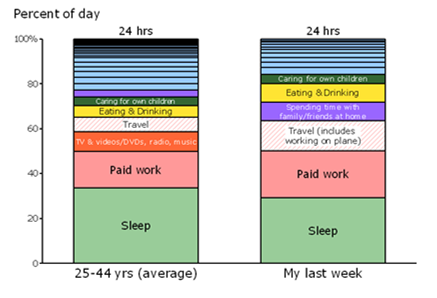
To see how I was faring against my fellow man, I checked out the 2008 American Time Survey. I found that the ‘average citizen’ spends 8hrs 30mins asleep each night and those that watched TV do so for 3hrs 40mins each and every day. Upon discovering this I instantly felt under slept and understood why I have only just finished the first season of Six Feet Under. Clearly I am no ‘average citizen’ so I turned to the 2005 UK Time Use study which breaks out 25-44 year olds and shows exactly what they do with every spare 5 minutes.
In order to compare myself to the ‘average 25-44yr old’ I went back and tracked every 15 minute chunk of time I had spent in the last 7 days. I mean every taxi, each airport meal, the calls to friends, the aimless surfing of the internet. If you haven’t ever done this exercise, I really don’t recommend it. It became readily apparent that my life is rushing by and I can’t even recall half the things I do each week. After nearly an hour of searching through my Outlook calendar I pieced together a loose approximation to my last seven days and proudly enter the data into Excel. Versus the average person my age I am spending more time than average travelling (which I already knew), I spend less time watching TV (again -not news, I have three seasons of Lost on DVR) and I work longer than average.
However the interesting stuff on this chart is all hidden away in the little blue segments at the top of the two bars. All the smaller moments of time that don’t fall into bigger buckets. Instead of looking at how I spent my time I decided to ask myself the question: “Where do I get my energy?” I drew a calendar breaking out my time for the week. I went through it and looked at: Where I had been most productive? Where I had wasted time? Where I had really enjoyed myself? Where did I have my best ideas? This was much more revealing.
On Wednesday afternoon I realized I should have run a meeting very differently. Then I noticed that each time I had gone running for 30 minutes I had had a much better day. Finally I made the totally obvious but nonetheless big observation that hanging out and playing with my baby daughter beats aimlessly surfing wikipedia any day.
Back in mid-90s at university, my tutor taught us how Economics is the study of scarce resources between competing ends. Of course life is just the same. We can't choose our parents, our genes or our taste in music. But we do get to choose how we spend our money, time and energy. After spending this last week up in the air, I am going to focus much more on what truly energizes me.
Tough questions
1. How do you really spend your time today?
2. Reflecting on your past week, where did you draw the most energy? How can you repeat that more consistently?
3. If you had to do the last week again, what would you do differently?
My morning coffee in Brooklyn last week feels like four years ago. Since then I have presented in Boston, trained in Los Angeles, passed through Denver, narrowly avoided running into a buffalo in Wyoming and am now en route to Vancouver. While I might picture myself as George Clooney’s Up In The Air character jetting at 35,000 feet, the reality is a lot less glamorous. For starters, I have no airline status so upon entering each aircraft I have to turn right. So as I sat in non-reclining seat 43G, I reflected on how I currently spend my time each week and whether I could be doing things differently.
To see how I was faring against my fellow man, I checked out the 2008 American Time Survey. I found that the ‘average citizen’ spends 8hrs 30mins asleep each night and those that watched TV do so for 3hrs 40mins each and every day. Upon discovering this I instantly felt under slept and understood why I have only just finished the first season of Six Feet Under. Clearly I am no ‘average citizen’ so I turned to the 2005 UK Time Use study which breaks out 25-44 year olds and shows exactly what they do with every spare 5 minutes.
In order to compare myself to the ‘average 25-44yr old’ I went back and tracked every 15 minute chunk of time I had spent in the last 7 days. I mean every taxi, each airport meal, the calls to friends, the aimless surfing of the internet. If you haven’t ever done this exercise, I really don’t recommend it. It became readily apparent that my life is rushing by and I can’t even recall half the things I do each week. After nearly an hour of searching through my Outlook calendar I pieced together a loose approximation to my last seven days and proudly enter the data into Excel. Versus the average person my age I am spending more time than average travelling (which I already knew), I spend less time watching TV (again -not news, I have three seasons of Lost on DVR) and I work longer than average.
However the interesting stuff on this chart is all hidden away in the little blue segments at the top of the two bars. All the smaller moments of time that don’t fall into bigger buckets. Instead of looking at how I spent my time I decided to ask myself the question: “Where do I get my energy?” I drew a calendar breaking out my time for the week. I went through it and looked at: Where I had been most productive? Where I had wasted time? Where I had really enjoyed myself? Where did I have my best ideas? This was much more revealing.
On Wednesday afternoon I realized I should have run a meeting very differently. Then I noticed that each time I had gone running for 30 minutes I had had a much better day. Finally I made the totally obvious but nonetheless big observation that hanging out and playing with my baby daughter beats aimlessly surfing wikipedia any day.
Back in mid-90s at university, my tutor taught us how Economics is the study of scarce resources between competing ends. Of course life is just the same. We can't choose our parents, our genes or our taste in music. But we do get to choose how we spend our money, time and energy. After spending this last week up in the air, I am going to focus much more on what truly energizes me.
Tough questions
1. How do you really spend your time today?
2. Reflecting on your past week, where did you draw the most energy? How can you repeat that more consistently?
3. If you had to do the last week again, what would you do differently?
Thursday, March 18, 2010
Three automation experiments that worked
Time to read: under three minutes.
I actively detest shopping. I derive no satisfaction from department stores. When I was eight I got lost in Selfridges in London for what felt like three days. I still experience flashbacks. So no surprises that I love online shopping. There is nothing I like more than opening my front door on a Saturday morning and the nice men from Freshdirect handover boxes of fresh veg and goodies for the week ahead. In fact I got thinking about other repetitive tasks that I dislike and what can be done so I never have to do them again. Here are three New York experiments that I tried and really liked.
1. Socks. I recently signed up to Manpacks. Although it sounds like a dodgy online service for discounted viagra, it is actually a subscription service that delivers fresh new socks, boxer shorts and t-shirts to my front door every two months. Buying socks in a store is time I can never get back. I had already switched to using Amazon.com but now this is even easier. One ‘manpack’ every two months will, on average, replace my wardrobe over two years. Brilliant.
2. Checking voicemail. For some reason I really dislike having to check my voicemail. I tend to do it about once every three weeks and delete all my messages at speed. I signed up to a service most excellently named: voicemailsucks.com. The product is called Phonetag and it automatically transcribes every voicemail you get and emails it to you. I must admit that I love it. It transcribes about 90% of the message correctly and, if you are confused, it also sends you an MP3 of the voicemail. Importantly it always seems to transcribe phone numbers that people read out correctly. I pay per message and the cost is negligible.
3. Never run out of toilet paper again. My wife and I signed up to Alice which automates the delivery of boring household goods to your house. It predicts when you will need various good like toilet cleaner or shampoo or recycling bags. Every few weeks a box arrives with stuff we need. No longer to we have to having a soul destroying marital conversation about laundry detergent. Now of course you do have to tell the website how often you go through various products and then adjust it if you over or under-estimate your consumption. But now it sends me a new toothbrush every four months and I know it’s time to throw out the old one. I simply don’t have to think about it. Shipping is also free which is nice.
I actively detest shopping. I derive no satisfaction from department stores. When I was eight I got lost in Selfridges in London for what felt like three days. I still experience flashbacks. So no surprises that I love online shopping. There is nothing I like more than opening my front door on a Saturday morning and the nice men from Freshdirect handover boxes of fresh veg and goodies for the week ahead. In fact I got thinking about other repetitive tasks that I dislike and what can be done so I never have to do them again. Here are three New York experiments that I tried and really liked.
1. Socks. I recently signed up to Manpacks. Although it sounds like a dodgy online service for discounted viagra, it is actually a subscription service that delivers fresh new socks, boxer shorts and t-shirts to my front door every two months. Buying socks in a store is time I can never get back. I had already switched to using Amazon.com but now this is even easier. One ‘manpack’ every two months will, on average, replace my wardrobe over two years. Brilliant.
2. Checking voicemail. For some reason I really dislike having to check my voicemail. I tend to do it about once every three weeks and delete all my messages at speed. I signed up to a service most excellently named: voicemailsucks.com. The product is called Phonetag and it automatically transcribes every voicemail you get and emails it to you. I must admit that I love it. It transcribes about 90% of the message correctly and, if you are confused, it also sends you an MP3 of the voicemail. Importantly it always seems to transcribe phone numbers that people read out correctly. I pay per message and the cost is negligible.
Thinking about all the incoming "stuff" that bombards me made me consider all the other ways that I have to deal with incoming information. To the extent that it is possible, I have tried to make everything end up in one place – either my Outlook inbox or my Blackberry (which is also my phone). OK that's two places. Here's where I am:
3. Never run out of toilet paper again. My wife and I signed up to Alice which automates the delivery of boring household goods to your house. It predicts when you will need various good like toilet cleaner or shampoo or recycling bags. Every few weeks a box arrives with stuff we need. No longer to we have to having a soul destroying marital conversation about laundry detergent. Now of course you do have to tell the website how often you go through various products and then adjust it if you over or under-estimate your consumption. But now it sends me a new toothbrush every four months and I know it’s time to throw out the old one. I simply don’t have to think about it. Shipping is also free which is nice.
So nothing mind-blowing here but just a few (America-centric) experiments that worked. And no reason to visit Selfridges or Bloomingdales ever again.
Tough questions
1. What are the most common repetitive tasks that you don’t enjoy?
2. How could you automate them or delegate them to someone else?
Thursday, March 4, 2010
In praise of putting your feet up
This is the story of how I re-organized two filing cabinets of old notes, threw out 28 boxes of junk and finally sorted out the outside closet. All while sipping tea with my feet up on my couch.
Time to read this post: 3 minutes

I like the idea of being organized. I go to friends' houses and admire their zen-like living rooms. I buy books like "Getting Things Done" by David Allen and put them neatly onto my bookshelf. But whenever I write "organize junk in home office" on my to-do list for Saturday morning, I am always unable to complete it because I urgently need to read the new Economist. For three hours.
I recently picked up a copy of "Organizing from the Inside Out" by Julia Morgenstern. It has 320 pages of proposals to analyze your clutter, creating action plans and getting the job done. I tried to read chapter 17 on "Closets. What's working? What's holding you back?". I read Julie's No-Brainer Toss List for Handbags and Briefcases. I even tried to diagnose whether the root cause of my issues were
Level 1: Technical errors - simple mechanical mistakes in my organization
Level 2: External realities - as far as I can work out, this one basically means that you're screwed
Level 3: Psychological obstacles (e.g. #12 Are you a highly visual person? #19 Did you have a traumatic childhood?).
Now I have no doubt that everything in the book is extremely sensible but every few sentences I found myself urgently needing to take a twenty minute nap. So what to do?
Well the answer is extraordinarily simple. Get someone else to do it for you. Lots of people love organizing things. They write books about it. They buy all the books about it. They do it for a living. And you too can pay them to do it all for you. Without having to address any psychological obstacles or technical errors. And they're surprisingly good value.
So my wife and I contacted Nicole at Genius Organizing and booked ourselves in for a home session with her. Nicole told us to order in some good food, have some good music ready on the iPod and she'd show up at 6pm for a 3 hour blitz. She sent us a nice email telling us not to think about our clutter a moment longer and she would fix everything. And, quite to my astonishment, she did.
The actual evening was somewhat of a blur. It involved Nicole marching around demanding things like: when we had last ever opened a particular filing cabinet. "Um" I would reply, "about twice a year". So she told us that 'We're going to scan it all in so you can have it all electronically and pull it up faster than you can find it in the piles of junk'. And by "we" she meant her and her colleague, Julie.
Julie arrived to pick up piles of my MBA lecture notes. She would scan them all in for us, categorize them into electronic folders and deliver them all back on one USB stick. Then I thought our closet was in reasonable shape. Apparently I was mistaken. We were able to throw out 28 bags of junk including many random objects that have followed us around the world as we moved and I didn't even recognize. And by the way, I don't mean plan to throw it out, I mean throw out. By 9pm it was all sitting outside ready to be picked up by Brooklyn's loudest garbage collection men at 4am. This really was genius.
So that was it. Oh and I just found out this week is National Procrastination Week. Watch this for a brilliant guide for how to procrastinate properly:
Time to read this post: 3 minutes

I like the idea of being organized. I go to friends' houses and admire their zen-like living rooms. I buy books like "Getting Things Done" by David Allen and put them neatly onto my bookshelf. But whenever I write "organize junk in home office" on my to-do list for Saturday morning, I am always unable to complete it because I urgently need to read the new Economist. For three hours.
I recently picked up a copy of "Organizing from the Inside Out" by Julia Morgenstern. It has 320 pages of proposals to analyze your clutter, creating action plans and getting the job done. I tried to read chapter 17 on "Closets. What's working? What's holding you back?". I read Julie's No-Brainer Toss List for Handbags and Briefcases. I even tried to diagnose whether the root cause of my issues were
Level 1: Technical errors - simple mechanical mistakes in my organization
Level 2: External realities - as far as I can work out, this one basically means that you're screwed
Level 3: Psychological obstacles (e.g. #12 Are you a highly visual person? #19 Did you have a traumatic childhood?).
Now I have no doubt that everything in the book is extremely sensible but every few sentences I found myself urgently needing to take a twenty minute nap. So what to do?
Well the answer is extraordinarily simple. Get someone else to do it for you. Lots of people love organizing things. They write books about it. They buy all the books about it. They do it for a living. And you too can pay them to do it all for you. Without having to address any psychological obstacles or technical errors. And they're surprisingly good value.
So my wife and I contacted Nicole at Genius Organizing and booked ourselves in for a home session with her. Nicole told us to order in some good food, have some good music ready on the iPod and she'd show up at 6pm for a 3 hour blitz. She sent us a nice email telling us not to think about our clutter a moment longer and she would fix everything. And, quite to my astonishment, she did.
The actual evening was somewhat of a blur. It involved Nicole marching around demanding things like: when we had last ever opened a particular filing cabinet. "Um" I would reply, "about twice a year". So she told us that 'We're going to scan it all in so you can have it all electronically and pull it up faster than you can find it in the piles of junk'. And by "we" she meant her and her colleague, Julie.
Julie arrived to pick up piles of my MBA lecture notes. She would scan them all in for us, categorize them into electronic folders and deliver them all back on one USB stick. Then I thought our closet was in reasonable shape. Apparently I was mistaken. We were able to throw out 28 bags of junk including many random objects that have followed us around the world as we moved and I didn't even recognize. And by the way, I don't mean plan to throw it out, I mean throw out. By 9pm it was all sitting outside ready to be picked up by Brooklyn's loudest garbage collection men at 4am. This really was genius.
So that was it. Oh and I just found out this week is National Procrastination Week. Watch this for a brilliant guide for how to procrastinate properly:
Subscribe to:
Posts (Atom)